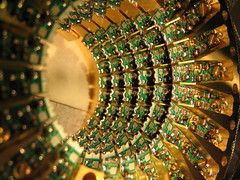
First Commercial Quantum Computer

D-Wave just demonstrated the first commercial quantum computer. I think it’s too early to say whether the current quantum computing technology is practical, but a promising commercial effort is a good sign.

Quantum computers could represent the sixth generation (electromechanical, relay, vacuum tube, transistor, integrated circuit) of digital computing. They are unlikely to ever replace integrated circuits, but will function as specialized processors for certain (NP-complete) types of problems common in simulating real life and encryption. (Incidentally, quantum computing may one day break all current methods of encryption, but also to introduce theoretically-unbreakable encryption – which has the Feds sniffing.)

Quantum Computer Photo

Originally uploaded by jurvetson.

New article on Environmentalism on the Objectivism Wiki

I’ve started a wiki article on the Objectivism Wiki to serve as a resource on environmentalism. Here is the introduction:

Philosophically, the essential principle of the ideology of environmentalism is the belief that “nature” has inherent moral value, and therefore the influence of man, and especially that of industrial civilization, is evil. Politically, this means the advocacy of various limits on industrial civilization, since all productive human activity has some kind of byproduct. While few (but alarmingly many) advocates of environmentalism recognize it as such, the ultimate goal of the environmentalist movement is the total destruction of industrial civilization, and the vast majority of the human race whose existence is made possible by it.

Please contribute!

Digg: Chavez fixes prices,profit motive evaporates,Result: massive food shortages

CARACAS, Venezuela — Meat cuts vanished from Venezuelan supermarkets this week, leaving only unsavory bits like chicken feet, while costly artificial sweeteners have increasingly replaced sugar, and many staples sell far above government-fixed prices.

read more | digg story

But who guards the guards?

120 prisoners escaped from a North Korean concentration camp yesterday. They were imprisoned for the crime of .. trying to escape from North Korea.

In related news, an entire platoon of border guards (one of the most lucrative jobs in that country) escaped the next day.

Both groups were risking their lives to escape to Manchurian China, which is a very poor and totalitarian area itself, and which helpfully returns escapees to North Korea for continued torture and starvation.

Aren’t you glad that the U.S. government has sent the North Korean slavemasters over $1 billion in aid since 1995?

Whenever I read these stories, I think of Ayn Rands words: “If they ask you, in America—tell them that Russia is a huge cemetery and that we are all dying slowly.”

Blame interventionism, not capitalism

There is much discussion on Slashdot about a new cancer drug that may never get on the market because it’s not eligible for a patent. Because getting a drug past the FDA costs up to a billion dollars, no drug company is willing to put up the costs when it can’t secure a monopoly. Most readers blamed capitalism for this. My response:

The problem is that drug approval costs so much. The major drug companies are happy with this – a billion dollars is too much for any innovative new startups to get to market. This is not the fault of capitalism, but the opposite – of government interventionism. In a free market, competing private organizations would decide when products are safe, and consumers would be free to choose what risks to take.

By contrast, the FDA creates giant monopolies that exclude competition by lobbying the government for more regulations and “safety controls” to raise barriers to entry, while millions of people die because innovative new medicines and treatments never had a chance.

New Virgin America airline goes viral video to make its case

Virgin America is trying to become the nation’s newest low cost air carrier (complete with touch screen displays, vod, satellite tv, broadband Internet and then some), but has been denied by the Department of Transportation. Virgin makes their case in the video seen in this story and asks for the publics help in lobbying support.

read more | digg story

Relationship between intellectual property and consumer electronics prices

Is it reasonable to expect all high-tech products coming out today to be cheaply available in the future?

Of course it’s a truism nowadays that electronics are getting better and cheaper all the time, but I wonder if we can generalize to the following argument:

Consumer electronic products (I am speaking mostly about audio/video/computer products) have three somewhat unique properties. First, they are relatively low bandwidth and low power, due to the hardware limitations of homes and consumption by a few people. Second, they are mass-produced. Third, they are mostly information products, which means that are not limited to any particular form of material.

These properties are especially suitable to rapid innovation and a trend towards automation of production. The trend has accelerated with the shift from analog to digital, which makes data integrity much easier. The key to the process is that increasing automation shifts production costs from manufacturing and materials to design. More and more of a products retail costs becomes intellectual property. For example, low-end DVD players can be found for under $30. I read somewhere that the licensing required to decode DVDs alone costs about $20. (This is also about the cost of a DVD plug-in for Windows Media Player.)

Are the any inherent cost factors I’m overlooking?

Let me put the question another way: today or soon, a $3,000 LCD TV might cost $30 in raw materials and $30 in labor, and the rest in intellectual property. (Those numbers are WAGs.) Is there any reason to think that it would not be $60 in 15 years, when the IP has expired and/or been reverse-engineered?

Discuss here.